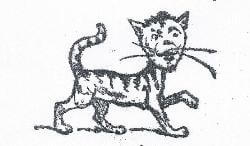
HEX CAT
- Program
- Subject
- Location
- Lat/Long
- Grant Recipient
-
Legends & Lore®
-
Legend
- Tumbling Run Rd, Pottsville, PA 17901, USA
- 40.679695, -76.172544
-
The Walk In Art Center
HEX CAT
Inscription
HEX CATFOUR-FOOT-LONG CAT
SAID TO HAVE TERRORIZED
THOMAS FAMILY AND OTHERS
AT TUMBLING RUN CIRCA 1912
AMID WITCHCRAFT SCARE.
THE PENNSYLVANIA CENTER FOR FOLKLORE
WILLIAM G. POMEROY FOUNDATION 2021
In the early twentieth century, in the Tumbling Run Valley tucked in the mountains of Schuylkill County, a witchcat known as the “Hex Cat” haunted the Thomas family and the surrounding Coal Region. The mysterious prowler could expand to four-feet-long and then contract to normal size at will, and its presence had an uncanny effect on farm animals, where hens crowed like roosters, pigs barked like dogs, and cattle, horses, and poultry died without explanation. The Hex Cat’s origin and purpose were a matter of speculation. The Thomas family was told someone in Orwigsburg, Pennsylvania, had placed a curse on them, and the Hex Cat, they believed, was the witch’s familiar.
Multiple witnesses reported seeing the Hex Cat make regular visits to the Thomas barnyard in the early morning hours. Some thought the Hex Cat to be a harbinger of death, and this proved true for Howell Thomas, the patriarch of the Thomas family, who died during this feline haunting, possibly of a stroke, but possibly due to the malignant curse. Howell left behind two daughters, one married, Sarah Potts, and one unmarried, Mary Thomas. The unmarried daughter accused the married daughter, at their father’s funeral no less, of beckoning the Hex Cat to the family’s property, in a devious attempt to rid the Thomas homestead of her sister, her father, and her Uncle William Thomas and claim the property for herself. (Whether or not the accusation against Mary Thomas was true, the inversion of the tale is notable. In British Isles folklore, spinsters are often accused of witchcraft. In this case, the unmarried woman is the accuser, and the married woman the accused.)
The remaining Thomas family attempted to rid themselves of the witchcat, but no matter how true their aim, bullets reportedly had no effect, only causing the Hex Cat to temporarily expand in size. Consulting a local witchdoctor, in Pennsylvania Dutch tradition known as a braucher or a pow-wower, the Thomas family learned that lead bullets would not work. Only solid gold would put an end to the Hex Cat. The Thomas family fashioned a bullet out of a five-dollar gold piece and laid in wait for the Hex Cat to return. But they never saw the Hex Cat again, and no kill was ever announced. The community developed several explanations. Some believed the cat’s sudden absence was the Thomases’ fault. The family had taken to loading themselves with crucifixes, talismans, amulets, and any other possible protection from the cursed witchcat. The Hex Cat may have slunk away, or it may have carried on haunting Schuylkill County, harassing other residents and begetting other misfortunes, as there were continued reports of unexplainable occurrences and tragic accidents.
Another explanation was that the Hex Cat was run off by another legendary cat. A Schuylkill Haven man was said to be in possession of a hexa-hemeron cat. This magical cat was born in a litter of six cats on the sixth day of the sixth month in 1906 and was blind for the first six days of its life. Hex is the Greek word for six, an important number in the Book of Genesis because of the creation of the world in six days. Hemeron comes from the Latin “hemera,” meaning days. The hexa-hemeron cat is found in the Pennsylvania Dutch pow-wower’s Sixth and Seventh Book of Moses. In that grimoire, the witch Endor gives the hexa-hemeron cat the power to ward off evil spells. It was speculated that the hexa-hemeron cat had run off the witchcat before the Thomas family could use their gold bullet, and that the good cat’s presence would restore the Thomas homestead.
But the Thomas family was far from restored. In media accounts, the Hex Cat story resurfaced in 1916, when William Thomas, brother of Howell Thomas, was charged with arson for burning an entire city block. After a short imprisonment, he was found frozen to death in a shack in the Tumbling Run Valley. William had been living as a hermit ever since the witchcat incident.
Cats have a long history in the supernatural folklore, and this particular legend blends regional and ethnic supernatural tradition, specifically that of Pennsylvania Dutch powwow with concerns of British Isle cats and witchcraft, providing an intriguing peek into folkloric practices and beliefs in Pennsylvania in the early twentieth century, ones that affected whole communities. The Motif-Index of Folk-Literature suggests that the motif of a large destructive cat may have connections to much older Irish and Welsh tales, though these stories usually emphasize the cat’s general destructiveness rather than its torment of one particular family.
The Tumbling Run Reservoir was once a popular resort, though, as may be expected from an area plagued by the Hex Cat, all manner of mishap and misfortune befell it even at the height of its success. A perusal of local newspaper accounts of the era shows a rising concern about, or at the very least a serious interest in, witchcraft in the area, which may have contribute to the Hex Cat lagend. Today the Tumbling Run Valley is a bucolic destination for hikers and tourists to enjoy Pennsylvania’s natural landscape and history.